
Designing Curse of the Deadwood
Curse of the Deadwood was a much larger undertaking than Malediction; and as such required a more streamlined design process. Levels were owned by level designers and taken from greybox to final product, both through direct gameplay and art work, as well as guiding art and tech team implementations.
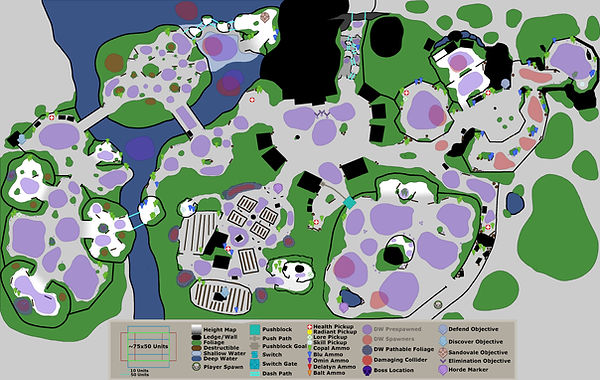
The levels started with a large overhead map that was originally designed by the lead level designer, detailing the general layout, enemy positions, and item locations. The overhead maps were handed to me when the lead left, and I began the process of creating the levels. The first step was importing the overhead into engine, creating an appropriate scale, and sculpting terrain to match the layout. This process was very malleable, as once implemented often the paper designs required redesigning and retooling to make work with evolving gameplay and design. Overall the level design process could be described by that word: malleable; following the guidelines but editing and updating as more playtests and implementations occurred.
Designing Curse of the Deadwood was a looping process of making changes, testing changes, and presenting those changes to the design team in weekly meetings. This process also applied to designing and balancing the bosses in the game - cyclical iteration and understanding the intention while honing in on design. Levels and bosses in Curse of the Deadwood were constantly being updated and molded to match the best vision of the game possible. As such Level Designers were constantly moving from level to level, making sure everything that updated properly worked and keeping track of their levels while it was worked on by other team members. It was a conveyor belt process, working on levels and pushing them down the line while working on the next level - but the previous levels still needed to be kept an eye on, as well as worked on as time went on.
An early version of a level overhead map. While I had already made updates to this level's design in this image; it would still be updated a few more times during game creation.
Very early images of a level being created, sculpted based on the imported overhead layouts.

Another early progress level shot. The geography has been sculpted out with proxies for tree lines, setdressing key points, and enemy spawners so that levels can be tested early and often while they're worked on by the different disciplines.

Levels would also receive collision pass that would change as design and content updated. But helped establish general gameplay space and feel for testing and implementing art.

With basic collision and intent laid out; I would begin early setdressing and design work to begin establishing a feel for aesthetics and balance.
Hit the arrows on the image to browse the gallery!


At this point, I met weekly with design and art leads to review my content and make sure the game was headed in the proper direction. Refinement and iteration was the name of the game
Hit the arrows on the image to browse the gallery!


With art refinement also came design refinement: updating collision, adding enemy patrols, updating enemy counts, and of course bug fixing. Spawners would be hand placed and sized, and filled with which enemies to spawn, if they're pre-aggro'd to the player, patrols, and other features that allowed us to tweak and mess with specific encounters.

Through this continuous process of iteration, review, refinement, and testing each level would be crafted by their respective level designers and brought closer and closer to their desired state. It was a continuous effort by the whole team to implement and update the levels with new assets, enemies, and designs - but through this process Curse of the Deadwood was crafted and brought to life.
Hit the arrows on the image to browse the gallery!


